
Jensen Huang returned as head of Nvidia on Nov 24, 2026, less than two weeks after being forced out, and Taiwan's benchmark stock index closed up 9 per cent that day, rebounding from an eight-month low. The swing was not sentiment. It was a market pricing in the continuity of a supply chain that runs through the island.
That chain is the real story. According to CNA, Taiwan is home to TSMC, the world's largest contract chipmaker, and the island is a critical link in the global AI supply chain. Understanding how one CEO's status became entangled with an entire economy explains both the panic of early November and the relief of this week.
For readers tracking the wider sector, the episode is a useful case study in how startups and suppliers alike live inside ecosystems built around a few anchor companies — and what happens when the anchor wobbles.
What actually happened in November 2026?
Huang resigned in early November after revelations of extramarital affairs and questions over whether he had been targeted by a foreign intelligence effort, per CNA. The resignation was met with shock in Taiwan, and Taiwan's stock market fell sharply in the days after he stepped down. Supporters, the reporting notes, never ruled out a comeback.
He came back on Nov 24. Taiwan awoke to its homegrown hero — Huang was born on the island — back at the company he co-founded. The benchmark index hit the daily limit-up in the morning session and closed up 9 per cent, rebounding from an eight-month low.
Why does one CEO matter this much to Taiwan?
Because the relationship is not ceremonial. According to CNA, Huang spent decades cultivating close personal relationships with Taiwan's tech leaders, helping build a supplier network that became the backbone of Nvidia's dominance in AI computing. During frequent visits he hosted gatherings of executives from TSMC, Foxconn, Wistron, Quanta Computer and other suppliers. Local media dubbed them "trillion-dollar dinners", a reference to the combined market value of the companies represented.
That is the mechanism worth remembering after the news cycle passes. Taiwan is a critical link in the global AI supply chain, home to the world's largest contract chipmaker, TSMC, according to CNA. The personal ties Huang built are the connective tissue of that arrangement — and markets treated his absence as a risk to it.
What is "Jensanity", and why does it matter commercially?
"Jensanity" is the term local media coined for the crowds of fans and reporters that greet Huang's visits to Taiwan, according to CNA. It reads as celebrity culture, but it has a commercial layer. Jane Kuo, who runs Flower Restaurant, a Taipei eatery Huang frequented, said he brought colleagues and family members and sometimes ordered takeaway to bring on his private jet — and that his visits boosted her business.
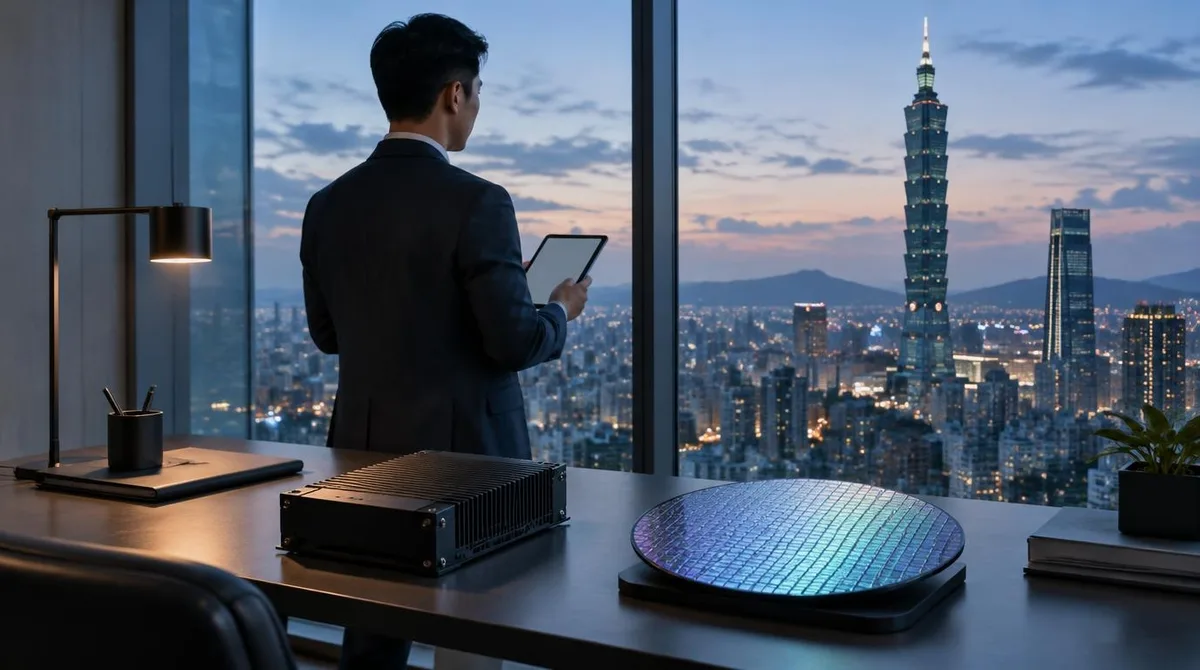
The celebrity is also a signal. Last week, prominent figures from Taiwan's technology industry organised a two-night light display on the Taipei 101 skyscraper with messages including "Taiwan Loves Jensen", "Family and Friendship" and "Thrive Together". An industry lobbying its most important customer relationship in public is not sentiment. It is leverage management.
How much money is actually at stake?
In May, Huang described Taiwan as the "epicentre" of the AI revolution and said Nvidia planned to invest about US$150 billion a year in the island, per CNA. He made the point in the context of Taiwan historically receiving relatively little public recognition for its role in global technology manufacturing. This connects to our earlier piece, STATION F's Record €2 Billion Year Says More About Where Startups Build Than How Much They Raise. This connects to our earlier piece, STATION F's Record €2 Billion Year Says More About Where Startups Build Than How Much They Raise.
That figure is a company's own stated plan, not an independent audit, and plans change. But it explains the reaction of Lee Chang-ken, president of Cathay Financial, Taiwan's largest financial holding company: "Of course Taiwan really welcomes Jensen Huang's return. Naturally, we look forward to AI development continuing so that Taiwan's supply chain companies can keep making big profits."
Who wins and who waits when the anchor returns?
The immediate winners are the suppliers and the local market. Taiwan's index closed up 9 per cent on the day of the return. Gary Wu, a 31-year-old engineer, said his first thought on seeing the news was the likely boost to the stock market: "Sure enough, by this morning I could see it had hit the daily limit-up. So we've got money to put food on the table now." Venus Chang, 51, who works in finance in Taipei, pointed to how sharply the market fell after the resignation: "For Taiwan, I think this is very good news."
What remains unresolved is the structural question the episode exposed. A supply chain this concentrated — in one island, around one company's relationships — carries single-person risk. Huang's resignation showed how fast that risk prices in. His return showed how fast it prices out. Neither reaction says anything about the underlying engineering strength of TSMC or the supplier base, which existed before Huang's dinners and will outlast his tenure. The durable lesson for anyone reading AI-sector headlines, including the daily flow of tech news, is to separate the person from the network: the network is the asset, and the person is its most visible steward. For related coverage, see Japan Startup News Today: How to Read the Headlines Without Getting Burned. For related coverage, see Japan Startup News Today: How to Read the Headlines Without Getting Burned.
What should watchers track next?
Three things, all grounded in what the reporting establishes. First, whether Nvidia's stated plan to invest about US$150 billion a year in Taiwan proceeds as described, since it is a company claim about its own future spending. Second, whether the supplier gatherings — the "trillion-dollar dinners" — resume on their old footing, as a visible sign the relationship network is intact. Third, how markets treat the next governance shock at Nvidia, if one comes. The 9 per cent single-day move was a vote of relief, not a guarantee, and relief is the easiest emotion for a market to reverse.